

Featured Article
Build With History, Not Hype: The DFS Edge Most Players Skip
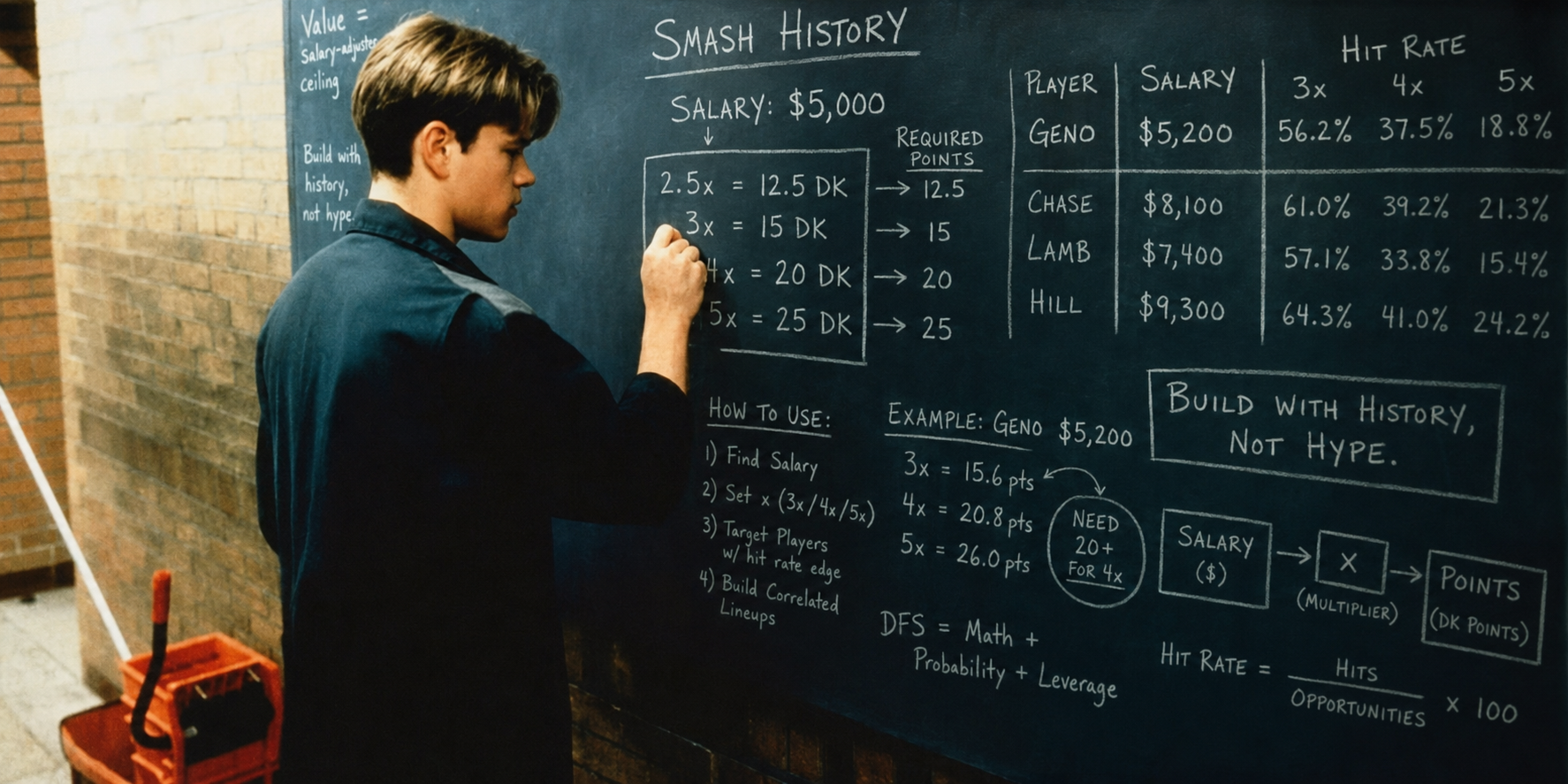
Most of us who play NFL DFS on DraftKings start with the same tools. We look at projections. We check ownership. Some of us run sims. Others lean on optimizers. All of it helps, but it also creates a problem. If we’re using the same tools, reading the same signals, and building from the same starting point, we need another way to find an edge.
That edge starts with one question.
Has this player ever scored the points needed to smash at this salary?I call the answer smash history.
DFS content creators spend all week talking about value. A player’s cheap. His matchup looks great. A projection says he’s underpriced. So every week the field starts moving toward the same names.
Some of those plays are good.
A lot of them are just easy to explain.
A player isn’t a value because he fits your lineup. He’s a value if he can score enough points for his salary to matter.
That’s the difference between points per dollar and smash history.
Points per dollar gives you the target.
Smash history tells you whether the player has reached that target before.
What Smash History Actually Measures
Smash history is salary-adjusted proof of ceiling.
Points per dollar is the basic math. It tells you what score a player needs to pay off his salary. Smash history takes the next step. It checks whether the player has actually hit that score before.
It doesn’t ask whether a player can score fantasy points.
It asks whether he can score enough points at his current salary to help you win tournaments.
Take a player priced at $5,000.
He needs 15 DraftKings points for 3x.
He needs 20 DraftKings points for 4x.
He needs 25 DraftKings points for 5x.
That’s the assignment.
A 22-point game can be a letdown at $8,000, a strong return at $5,000, and a slate-shaping score at $3,200.
Same score. Different salaries. Different results.
Raw fantasy points don’t tell the full story. A player doesn’t just need to score. He needs to score enough for what he costs.
Why Points Per Dollar Isn’t Enough
Points per dollar is useful, but it’s only the first step.
It tells you what a player needs to score. It doesn’t tell you whether he’s shown he can do it.
That’s where DFS players get sloppy.
We see a cheap salary and call the player a value. We see a good matchup and talk ourselves into a ceiling play. We see a strong projection and assume the salary is wrong.
Sometimes that works.
Plenty of times, it doesn’t.
The next question has to be sharper.
Has this player ever hit the score his salary requires?If he has, that matters.
It doesn’t mean he’s automatic. A player with strong smash history isn’t guaranteed to hit again. A player with weak smash history isn’t dead. Roles change. Matchups change. Injuries happen.
But if a player has already shown he can beat his salary, his upside case has evidence behind it.
If he hasn’t, you need another reason to believe.
Maybe a running back’s role changed. Maybe a wide receiver’s target share is about to rise. Maybe a quarterback’s matchup gives him a path he didn’t have before.
That’s fine.
At least you know what kind of bet you’re making.
You’re not just calling someone a value because he’s cheap. You’re asking whether that value has ever shown up at this kind of price.
That’s how you separate real tournament upside from surface-level value.
Geno Smith Was Hiding in Plain Sight
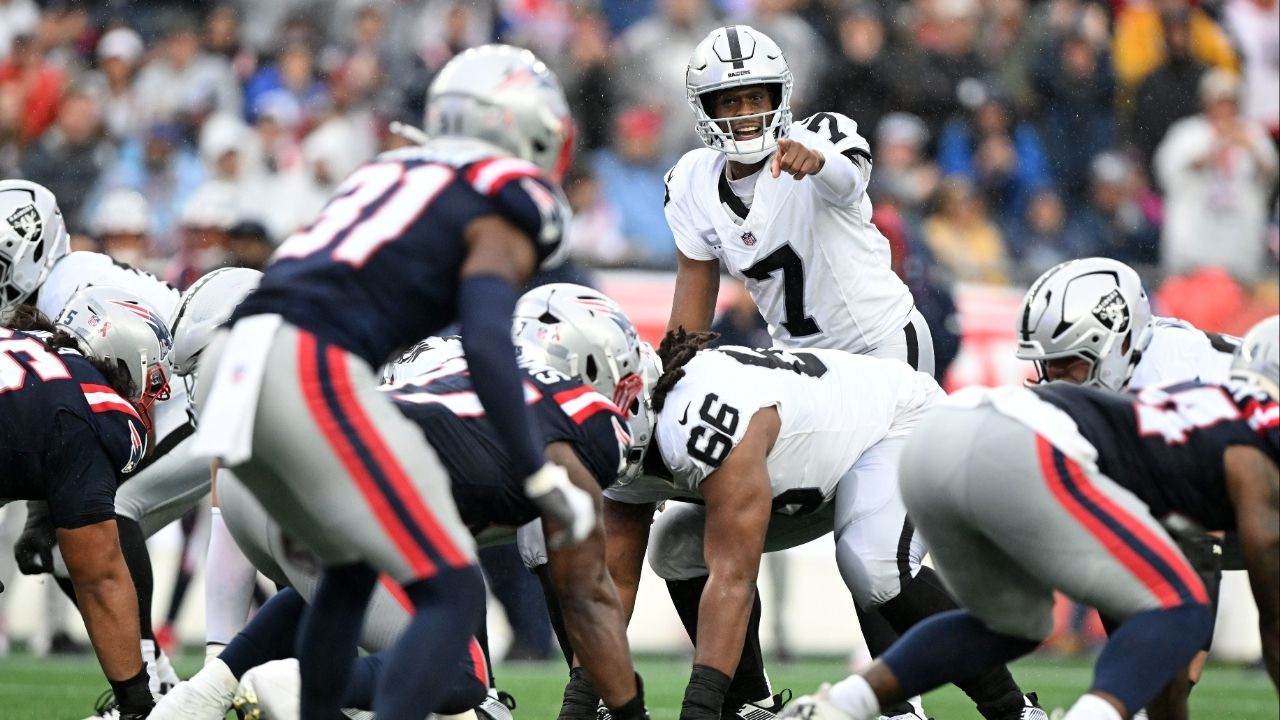
Geno Smith is a clean example.
In Week 1 of 2025, he wasn’t the quarterback the market wanted to talk about.
Joe Burrow had the name value.
Jayden Daniels had the rushing upside.
Those were the easier clicks. Those were the quarterbacks people felt better about building around.
Geno was different.
He was cheaper, less hyped, lower-owned, and easier to ignore.
That’s exactly the type of player smash history can help find.
Geno was $5,200 in Week 1.
Burrow was $6,900.
Daniels was $7,000.
That gave Geno $1,700 to $1,800 in salary relief. But salary relief only matters if the player can score enough to make it count.
That’s where Geno’s 2024 smash profile became useful.
Measured against his Week 1 salary, Geno had hit 2.5x in 75% of his 2024 games.
Burrow and Daniels were also at 75%.
At 3x, Geno had hit in 56.2% of his games.
Burrow was at 50%.
Daniels was at 62.5%.
So at the baseline value level, Geno was right there.
Then came the tournament number.
Geno, Burrow, and Daniels had all hit 4x in 37.5% of their games.
Same 4x rate.
The field wanted Burrow and Daniels. The smash history said Geno belonged in the same conversation.
At 5x, what’s known as the Ceiling Level, Geno and Burrow had both hit 18.8%.
Daniels had hit 12.5%.
So Geno didn’t just hold up. At the highest ceiling level, he matched Burrow and beat Daniels.
Player Week 1 Salary 3x Hit Rate 4x Hit Rate 5x Hit Rate Geno Smith $5,200 56.2% 37.5% 18.8% Joe Burrow $6,900 50% 37.5% 18.8% Jayden Daniels $7,000 62.5% 37.5% 12.5% The Point Isn’t Prediction
As is always the case, smash history didn’t predict the slate perfectly.
It didn’t guarantee Geno would outscore Burrow. It didn’t guarantee Daniels would land in a solid but not slate-breaking range.
It didn’t guarantee anything.
That’s not how DFS works.
But it did give you useful information when considering who to include in your lineups.
It told you Geno Smith was viable.
Not trendy.
Not obvious.
Not the comfortable click.
Viable.
In tournaments, that matters.
So how did Week 1 play out for Geno, Burrow, and Daniels?
When the games were played, Geno scored 21.5 DraftKings points against the Patriots. That was 4.1x.
Daniels scored 20.6 against the Giants. That was a 2.9x performance.
Burrow scored 8.8 against the Browns. A disappointing 1.2x outing.
So the cheaper, lower-owned quarterback outscored the two names the market preferred.
That’s the point.
Smash history gave you a reason to take Geno seriously before it happened. His salary-adjusted ceiling wasn’t fake. He had already hit the kinds of scores his Week 1 salary required.
While the field chased cleaner names, a cheaper quarterback sat in plain sight with a tournament-viable profile.
That’s the edge.
It’s not about finding the player everyone likes.
It’s about finding the player whose current salary gives him a real path to matter.
What SmashTracker Adds to the Process
In Week 1 of 2025 the information was there.
The salary was there.
The history was there.
But unless you had a way to organize it, you wouldn’t have seen it.
That’s what SmashTracker is built to do.
It’s not built to tell you who to play blindly. It’s not built to replace projections, ownership, optimizers, sims, stacks, or your normal DFS research.
It’s built to add a missing layer.
SmashTracker takes a player’s current DraftKings salary and turns that salary into the score he needs to hit.
Then it checks his past DraftKings results against that number.
How often has he hit 3x?
How often has he hit 4x?
How often has he hit 5x?
That’s the core of it.
Projections tell you what a player is expected to score.
Optimizers help you build lineups.
Sims show you how a slate can play out across thousands of possible outcomes.
SmashTracker helps you answer the question those tools don’t force you to ask.
How often has this player scored the points needed to smash at this salary?Build With History, Not Hype
DFS gets loud every week.
A cheap player gets pushed as value. A matchup gets sold as a ceiling spot. A projection makes someone look underpriced.
Then the field starts moving in the same direction.
Some of those plays will be right.
Plenty won’t be.
Smash history helps you slow down before the slate pulls you into the crowd.
It makes you ask better questions.
What does this salary demand?
How many points does this player need?
Has he hit that number before?
How often has he done it?
If he hasn’t hit that number before, has anything changed that gives him a better chance than before?
That’s how you build with history, not hype.
Access Smash History With SmashTracker
SmashTracker is built around this process, especially if you are a Season Pass Holder.
As a pass holder you get access to weekly position boards for quarterbacks, running backs, wide receivers, and tight ends.
You’ll be able to see each player’s salary, his 3x, 4x, and 5x targets, and how often they have hit those numbers.
Then you can use that information before building tournament lineups.
The bigger piece is the weekly Pass Holders-only Strategy Session video.
Every Saturday during the season, you will get a deeper breakdown of the current week’s SmashTracker position boards.
Not just data.
Not just numbers.
Not just a spreadsheet.
A real slate breakdown through the lens of smash history.
You can also submit questions through Discord before the show. That gives you a way to bring your own player questions into the process before lineups lock.
You get the boards. You get the weekly breakdown. You get a sharper way to prepare for the slate.
Season Pass: $99 for the season. Early bird access: $79 through August 15.
The Edge Is Applying It Before the Slate Gets Loud
Once the season starts, the edge won’t be knowing what smash history means.
The edge will be knowing how to use it before everyone else settles into the same plays.
The field will still chase projections. It’ll still react to ownership. It’ll still talk itself into cheap value and expensive names.
You don’t have to ignore that information.
You just need one more question before you follow it.
Has this player ever scored the points needed to smash at this salary?Build with history, not hype.